

Jul 29, 2026 Trump Accounts: A New Way to Give Your Kids (or Grandkids) a Head Start
If you have young kids or grandkids, you’ve probably seen the headlines: as of July 4, 2026, families can fund a brand-new type of account for children called a “Trump Account.” There’s been a lot of buzz — and a fair amount of confusion — so here’s a plain-English rundown of what these accounts are, how they work, and how they stack up against the tools families already use.
So what is a Trump Account?
Think of it as a starter retirement account for kids. Created by the 2025 One Big Beautiful Bill Act, a Trump Account lets money be invested on a child’s behalf long before they ever earn a paycheck. That matters, because a regular IRA requires earned income — which most 6-month-olds don’t have.
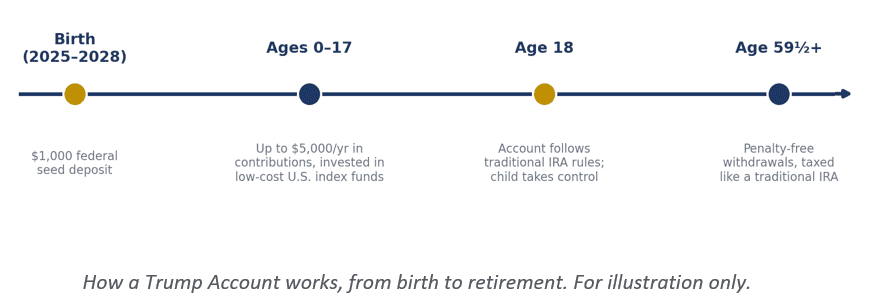
The headline feature: children who are U.S. citizens born between January 1, 2025, and December 31, 2028, can receive a one-time, government-funded $1,000 seed deposit. Important: the seed is not automatic. A parent or guardian must elect it (currently via IRS Form 4547) — simply being eligible, or even opening an account, isn’t enough. Kids born outside that window can still have an account; they just don’t receive the $1,000 seed.
Until the year the child turns 18, the money must stay invested in low-cost U.S. stock index funds (with fees capped at 0.10% per year), and withdrawals generally aren’t allowed. Starting at 18, the account follows traditional IRA rules: the child takes over, and the money can keep compounding tax-deferred for decades.
How money gets in
- Family and friends: Parents, grandparents — anyone — can contribute up to a combined $5,000 per child per year (indexed for inflation after 2027). Contributions are not tax-deductible.
- Employers: An employer can add up to $2,500 per year for an employee’s child — tax-free to the family — but it counts toward the same $5,000 cap. The income is excluded when contributed, but taxable on distribution, much like a traditional IRA.
- Charities and governments: Qualifying organizations can contribute too, and those dollars don’t count against the $5,000 limit. Neither does the federal seed money.
One coordination note: the $5,000 cap is per child, not per giver. If grandma contributes $5,000, that uses up the whole year for the grandchild. Families should talk before writing checks.
Why start so early? Because compounding is patient
The real gift here isn’t the $1,000 — it’s the 18-year head start. Money invested at birth has roughly 18 more years to compound than money invested at a first job, and under IRA-style rules that growth can continue tax-deferred for decades beyond that. The earliest dollars do the heaviest lifting.
Of course, markets don’t grow in a straight line — returns vary, can be negative, and are never guaranteed — and income tax is due on the growth when the money eventually comes out. It’s also worth knowing that, on an after-tax basis, a plain taxable custodian account can sometimes match or beat a Trump Account. That’s because Trump Account growth is eventually taxed at ordinary income (versus lower capital-gains rates), and for smaller balances, a child’s investment income may be taxed very lightly or not at all under the “kiddie tax” rules.
There may also be an argument that, on an after-tax basis, a taxable custodial account can match or beat a Trump Account (ordinary-income treatment of Trump Account growth vs. capital-gains rates, plus 0% kiddie-tax gain harvesting).
The fine print (and there is some)
- The money is locked up. No withdrawals until the year the child turns 18 — and after that, taking money out before age 59½ generally means income tax on the growth plus a 10% penalty, unless an exception applies (qualified education costs are one).
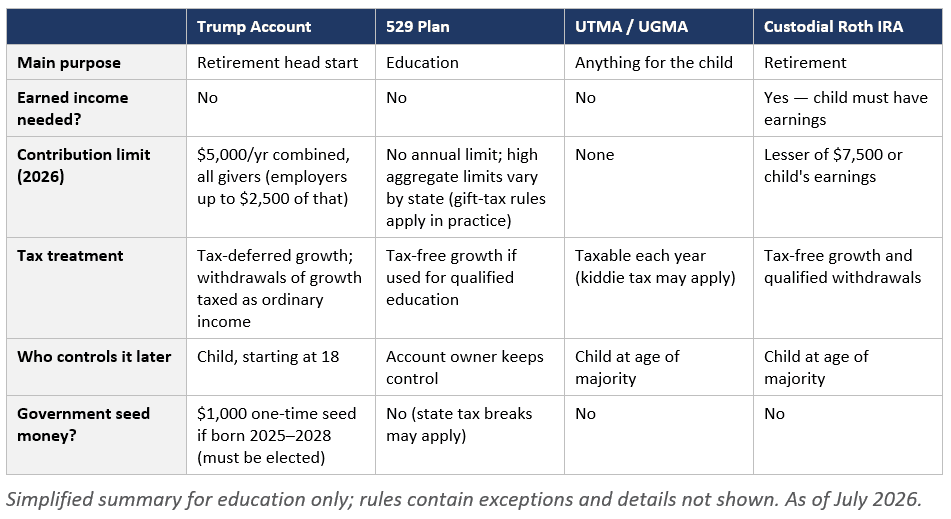
- Withdrawn growth is taxed as ordinary income, not at lower capital-gains rates. For education specifically, a 529 plan is usually the more tax-efficient tool.
- The child gets control at 18. Unlike a 529, parents can’t keep the keys or redirect the money to a sibling.
- Gift-tax treatment has been clarified. In June 2026, the IRS issued a safe harbor (Rev. Proc. 2026-25): in general, if your total gifts to a child for the year — including Trump Account contributions — stay within the annual gift-tax exclusion ($19,000 per person in 2026), no gift-tax return is required. Larger or combined gifts can still have filing consequences, so check with your tax professional.
- The rules are still settling. The IRS has issued initial guidance and proposed regulations, but some details remain proposed rather than final and could change.
How it compares to the usual suspects
The bottom line
A Trump Account isn’t a replacement for a 529, a custodial account, or anything else — it’s a new tool with a specific job: giving a child a tax-deferred retirement head start, sometimes with a government-funded seed attached. If your child or grandchild is a U.S. citizen born in 2025 or later, claiming the $1,000 seed is worth a conversation — remember, it must be elected. Whether to contribute beyond that depends on your family’s goals, and that’s where planning comes in.
The savings matter more than the vehicle. One practical note: for now, Trump Accounts are opened directly by parents through the government’s process (not set up or held at your advisor’s custodian), so our role is to help you understand the options rather than open the account for you.
Educational overview — not investment, tax, or legal advice [AI Assisted]
Sources
Ben Henry-Moreland, “An Advisor’s Guide To Opening 530A ‘Trump Accounts’,” Kitces.com (2026); Capital Group, “Trump Accounts, 529s and other ways to save for kids” (2026); Christine Benz & Tim Steffen, “Trump Accounts vs 529: Assessing the Pros and Cons,” Morningstar (2026); Congressional Research Service, “Trump Accounts: Overview and Policy Considerations,” R48910 (June 2026); IRS Notice 2025-68; IRS Rev. Proc. 2026-25 (June 2026); and TrumpAccounts.gov.
Disclosures: This material is provided by Leonard Rickey Investment Advisors, P.L.L.C. (“LRIA”) for educational and informational purposes only and does not constitute investment, tax, or legal advice or a recommendation to buy or sell any security or open any particular account. Portions of this article were prepared with the assistance of artificial intelligence and reviewed by LRIA personnel.[AI ASSISTED] Investing involves risk, including possible loss of principal; returns are not guaranteed. Tax rules for Trump Accounts are new, based in part on proposed regulations, and subject to change; figures cited are for 2026 and may be adjusted. Consult your tax professional regarding your specific situation.
Company News
Market Commentary
Retirement Planning
Tax Planning
Cyber Security
Important Disclosures
Leonard Rickey Investment Advisors, PLLC (“LRIA”), is an SEC registered investment adviser located in the State of Washington. Registration does not imply a certain level of skill or training. For information pertaining to the registration status of LRIA, please contact LRIA or refer to the Investment Adviser Public Disclosure website (www.adviserinfo.sec.gov).
This is provided for general information only and contains information that is not suitable for everyone. As such, nothing herein should be construed as the provision of specific investment advice or recommendations for any individual. To determine which investments may be appropriate for you, consult your financial advisor prior to investing. There is no guarantee that the views and opinions expressed herein will come to pass. This newsletter contains information derived from third party sources. Although we believe these third-party sources to be reliable, we make no representations as to the accuracy or completeness of any information prepared by any unaffiliated third party incorporated herein and take no responsibility therefore.
Any projections, forecasts and estimates, including without limitation any statement using “expect” or “believe” or any variation of either term or a similar term, contained here are forward-looking statements and are based upon certain current assumptions, beliefs and expectations that LRIA considers reasonable or that the applicable third parties have identified as such. Forward-looking statements are necessarily speculative in nature, and it can be expected that some or all of the assumptions or beliefs underlying the forward-looking statements will not materialize or will vary significantly from actual results or outcomes. Some important factors that could cause actual results or outcomes to differ materially from those in any forward-looking statements include, among others, changes in interest rates and general economic conditions in the U.S. and globally, changes in the liquidity available in the market, change and volatility in the value of the U.S. dollar, market volatility and distressed credit markets, and other market, financial or legal uncertainties. Consequently, the inclusion of forward-looking statements herein should not be regarded as a representation by LRIA or any other person or entity of the outcomes or results that will be achieved by following any recommendations contained herein. While the forward-looking statements here reflect estimates, expectations and beliefs, they are not guarantees of future performance or outcomes. LRIA has no obligation to update or otherwise revise any forward-looking statements, including any revisions to reflect changes in economic conditions or other circumstances arising after the date hereof or to reflect the occurrence of events (whether anticipated or unanticipated), even if the underlying assumptions do not come to fruition. Opinions expressed herein are subject to change without notice and do not necessarily take into account the particular investment objectives, financial situations, or particular needs of all investors.
For additional information about LRIA, including fees and services, please contact us for our Form ADV disclosure brochure using our contact information herein. Please read the disclosure brochure carefully before you invest or send money.
2026 2nd Quarter Investment Commentary